
For three days, the IU International University of Applied Sciences campus at Diesterwegplatz became a working lab for a different kind of classroom project. From June 12 to 14, roughly 150 participants — students, faculty, and members of the public — took part in the Design Democracy Camp, a series of workshops exploring how design, architecture, and social work can be combined to strengthen community engagement and public life.
The three-day programme was an official part of World Design Capital Frankfurt RheinMain 2026, an initiative that recognises cities using design to address social, environmental, and economic challenges.
The camp was organised around three thematic tracks, spanning eleven hands-on workshops, along with public panels featuring practitioners from design, architecture, social work, and civic organisations. Rather than aiming for finished solutions, the format prioritised collaborative exploration — testing ideas quickly, building prototypes, and gathering public feedback in real time.
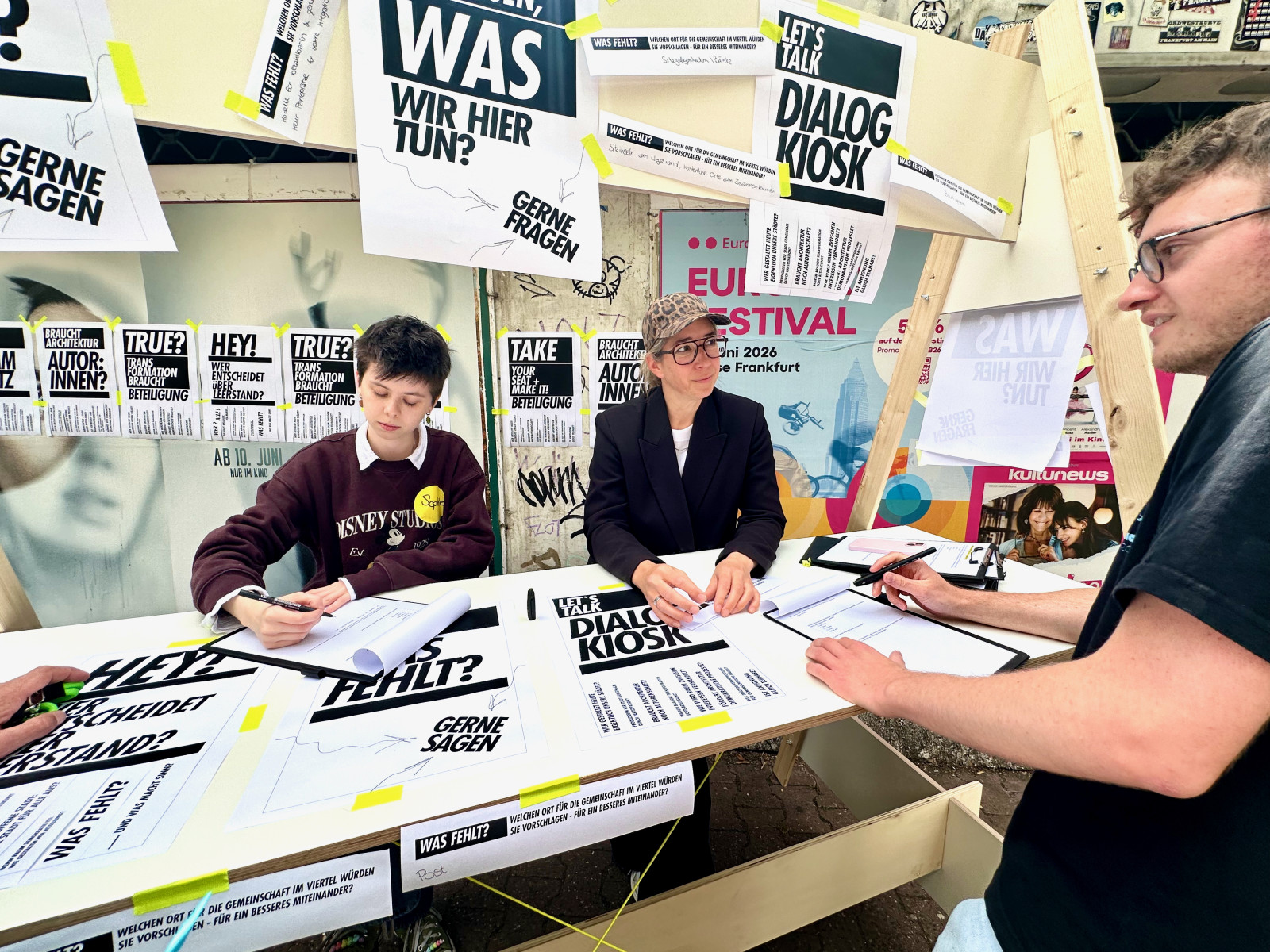
Project outcomes included proposals for activating vacant buildings, temporary public installations, visual communication concepts, and a design-build project called the Dialogue Kiosk — a modular, reusable piece of public furniture intended as a gathering point for community exchange.
"Good architecture begins with listening," said Prof. Dr.-Ing. Bettina-Maria Müller, Professor of Architecture at IU and project lead for the architecture track. "The Dialogue Kiosk shows how vacant spaces can be transformed into new places for learning and collaboration through participation and shared action."
Other workshops examined how visual design can translate community input into shared symbols and communication tools. "A shared future emerges where different perspectives meet," said Prof. Tanja Godlewsky, Professor of Media Design at IU. "Design creates the opportunities and spaces in which exchange gives rise to new ideas."
A school outreach workshop, "Memes for Democracy," invited local students to practice visual communication and media literacy skills, developing their own graphics on constructive online communication.
On the final evening, participants presented their work — posters, prototypes, the Dialogue Kiosk, and other visual projects — in a public exhibition on campus. Organisers reported strong turnout and engagement from passers-by, with many attendees stopping to discuss the projects and share their own ideas.
"Design makes issues visible, translates ideas into concrete experiences, and opens up new forms of participation," organisers noted. "In conjunction with architecture and social work, formats emerge that promote engagement and bring together diverse perspectives."
The event was led by Prof. Dr. Annelie Franke, Prof. Tanja Godlewsky, Prof. Dr.-Ing. Bettina-Maria Müller, and Prof. Holger Ziemann, with support from roughly 16 faculty members across media design, architecture, and social work. Participation was free of charge.
IU says the Design Democracy Camp is intended as a repeatable model rather than a one-time event — a format that could be adapted for other cities and institutions. The initiative reflects a broader push by universities to connect academic teaching with real-world, interdisciplinary projects that produce tangible community outcomes.



The World Design Organisation names a "World Design Capital" every two years to recognise a city or region using design for social, environmental, and economic development. In 2026, the Frankfurt RheinMain region holds the title under the theme "Design for Democracy — Atmospheres for a Better Life."

